Quick Summary
Remove the filter. Soak in hot water with dish soap or alkaline degreaser for 10 to 15 minutes. Scrub gently. Rinse until clear. Dry completely. Reinstall. Metal mesh and baffle filters can also go in the dishwasher on a hot cycle. Charcoal filters cannot be washed — replace every 3 to 6 months. Clean home filters every 2 to 3 months. Commercial filters every 2 to 6 weeks.
Grease does not announce itself. It builds slowly above your cooktop — on the filters, the canopy body, the fan blades, the duct collar — until airflow drops, cooking smells linger, and in a commercial kitchen the fire risk becomes measurable.
What Type of Filter Do You Have?
The cleaning method depends entirely on filter type. Identify yours before you start.
| Filter Type | Washable? | Best Method | Notes |
|---|---|---|---|
| Aluminium or stainless mesh | Yes | Hot soak or dishwasher | Most common in domestic hoods |
| Stainless baffle (commercial) | Yes | Soak or dishwasher | Standard in commercial canopy hoods |
| Charcoal / carbon | No | Replace only | Every 3 to 6 months |
| Cartridge (large commercial) | Professional only | Caustic soak + airflow test | Licensed contractor required |
Step-by-Step: How to Clean a Range Hood Filter
Step 1: Remove the filters
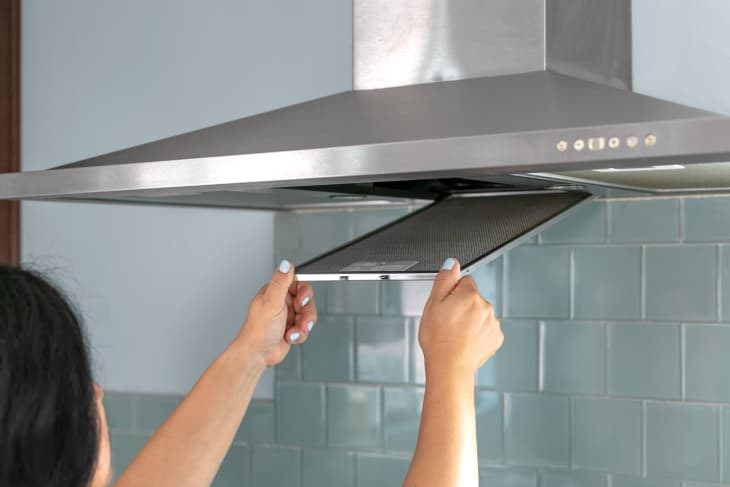
Turn the hood off at the wall. Slide or press the release tab on each filter and lower it out carefully. Place a tray underneath first — a heavily loaded filter can drip grease onto the cooktop below.
Step 2: Soak
Fill a sink or wide tray with the hottest water you can run. Add dish soap for home use, or an alkaline degreaser rated for stainless steel and aluminium for commercial-grade grease. Submerge flat for 10 to 15 minutes. For a filter not cleaned in over a month, soak for 30 minutes.
Step 3: Scrub and rinse
Work through the mesh with a soft-bristle brush. After a proper soak the grease should lift without heavy pressure. Rinse under hot running water until completely clear.
Step 4: The dishwasher shortcut
Metal mesh and baffle filters can go in the bottom rack of the dishwasher on a hot cycle. Skip the heated dry setting on aluminium frames — it can warp them. Let cool and air-dry completely before reinstalling. This is the standard end-of-service routine in most commercial kitchens.
Step 5: Dry completely, then reinstall
A damp filter traps moisture behind the mesh frame, corroding it from the inside. Stand filters upright to air-dry fully for at least one hour. Slide back until they click firmly. Run the hood on high for 30 seconds to confirm proper seating.
Cleaning the Stainless Steel Exterior
- Apply degreaser to a microfibre cloth — never spray directly onto the hood.
- Wipe with the brushed grain. Wiping across the grain leaves scratches that compound with every clean.
- The underside lip above the cooktop carries the heaviest grease.
- Dry immediately — water left to air-dry on stainless steel leaves mineral spots.
Never use on stainless steel: steel wool, bleach, chlorine-based cleaners, or abrasive scouring pads.
Cleaning the Grease Trap
- Remove the tray carefully.
- Tip collected grease into a sealed container — do not pour down the drain.
- Wash in hot soapy water, rinse, dry, and reinstall.
Cleaning the Interior Chamber
Grease on the fan blades creates rotational imbalance. Over time it works into the motor bearings. A commercial extraction fan motor replacement in Brisbane runs $2,500 to $4,000 installed.
- Turn power off at the wall.
- Wipe interior walls with a damp degreaser cloth.
- Wipe fan blades gently — do not bend them.
- Wipe the duct collar at the exhaust exit point.
- Dry all internal surfaces before reinstalling filters.
How Often Should You Clean Your Range Hood?
| Setting | Filters | Exterior | Grease Trap |
|---|---|---|---|
| Commercial high-volume (wok, deep fry, grill) | Every 1 to 2 weeks | Weekly | Every 1 to 2 weeks |
| Commercial moderate (restaurant, cafe) | Every 4 to 6 weeks | Fortnightly | Monthly |
| Home kitchen (daily cooking) | Every 2 to 3 months | Monthly | Every 3 months |
| Home kitchen (occasional cooking) | Every 4 to 6 months | As needed | Every 6 months |
Stainless Steel Range Hoods vs Other Hood Materials
| Property | Stainless Steel 304 | Painted Metal | Aluminium |
|---|---|---|---|
| Tolerates alkaline degreasers | Yes | Limited (strips paint over time) | With care |
| Baffle filter dishwasher-safe | Yes | Varies | Mesh types, yes |
| Surface repairable if scratched | Yes (re-grained) | No | Limited |
| Compliant with AS 4674 (commercial) | Yes | Dependent | Limited |
Commercial Kitchen Compliance: AS 1668.1
AS 1668.1 requires extraction systems to maintain their rated airflow throughout operating life. AS 1851 sets the mandatory cleaning trigger: grease deposits exceeding 0.2mm averaged across the system, or 2mm at any single point.
- In-house: Filters, canopy body, and grease trap cleaned on the schedule above.
- Professional contractor: Exhaust ducting and fan assembly cleaned every 6 to 12 months by a licensed contractor.
- Documentation: Maintenance records must be available for inspection by council fire safety officers and Food Authority inspectors.
Frequently Asked Questions
Can range hood filters go in the dishwasher?
Yes. Metal mesh and stainless steel baffle filters can go in the dishwasher on a hot cycle. Avoid the heated dry setting on aluminium frames. Charcoal filters must be replaced every 3 to 6 months.
How do I remove baked-on grease from a stainless steel range hood?
Lay a hot soapy cloth against the area for five to ten minutes. A baking soda paste works on stubborn residue without scratching. Never use steel wool or a metal scraper.
Why has my range hood become louder?
Increased noise usually means a clogged filter restricting airflow, a filter not seated correctly, or grease build-up on the fan blades causing imbalance. Clean the filters first.
What is the difference between a baffle filter and a mesh filter?
Mesh filters trap grease as air passes through layers of metal mesh. Baffle filters use angled metal channels to redirect airflow, causing grease to fall into a collection tray. Baffle filters are standard in commercial canopy hoods.
Do commercial kitchens need professional range hood cleaning?
Filters and canopy body can be cleaned in-house. Exhaust ducting and the fan assembly require a licensed contractor at intervals set by AS 1668.1 and AS 1851. Records must be kept and available for inspection.
How much does professional range hood cleaning cost in Brisbane?
Commercial exhaust cleaning typically starts from $200 to $400 for a single canopy, depending on size and grease load.