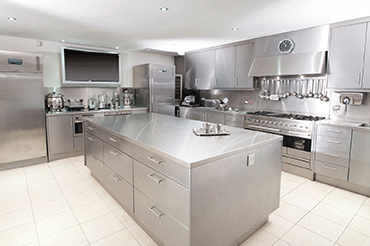
We fabricate and install stainless steel benches across Brisbane and Queensland commercial kitchens every week. We see what holds up and what does not. The benchtops we installed 12 years ago are still in service. The stone and laminate in comparable kitchens have been replaced at least once, sometimes twice.
This guide compares all three materials across the criteria that actually matter: hygiene, heat resistance, lifespan, repairability, custom sizing, and real cost over time.
Stainless Steel Benchtops
Hygiene. Stainless steel is genuinely non-porous — no microscopic pores for bacteria, mould, or food particles to settle into. It can be cleaned with any food-safe sanitiser without degrading the material. This is why it is the specified material under the FSANZ Food Standards Code and Australian Standard AS 4674 for commercial food premises. No other common benchtop meets this standard without caveats.
Heat resistance. Hot pans, commercial steam equipment, and direct heat can be placed on stainless steel without damage. Engineered stone cracks under thermal shock. Laminate scorches above approximately 120°C. In a kitchen where hot equipment moves across the bench constantly, those are daily operating conditions — not edge cases.
Lifespan and repairability. A correctly specified 304 grade stainless steel bench will outlast every other component in the kitchen. When stainless shows wear, it can be professionally re-grained and polished back without replacement. Stone slabs and laminate panels cannot be resurfaced — damage means pulling the whole section out.
For a full breakdown of which grade suits your environment, see our 304 vs 316 stainless steel guide.
Custom sizing. No standard sheet size limits. No joins required across any run length. Integrated sink cutouts, tap holes, splashback returns, drain grooves, and equipment recesses all built into a single fabricated piece. Not possible with stone or laminate.
Where it falls short. Shows fingerprints and water spots more readily than stone. The look is industrial and professional — right for commercial kitchens and contemporary residential builds, not for a traditional home kitchen where the benchtop is meant to be a decorative centrepiece.
Engineered Stone Benchtops
Silica fabrication ban — know this before specifying: From 1 July 2024, engineered stone products containing more than one percent crystalline silica have been banned from fabrication in Australia following documented cases of silicosis in fabrication workers. Some compliant products continue to be available below this threshold. Confirm silica content with your supplier before specifying new engineered stone.
Where it genuinely excels. The widest visual range of any common benchtop material. Colours, patterns, and finishes not available in stainless or laminate. Very scratch resistant under normal residential use.
The heat problem. The polymer resin binder expands at a different rate to the quartz aggregate under sudden temperature changes. Hot cookware placed directly on the surface can cause cracking or discolouration. Trivets and heat pads are required, not optional.
The hygiene limitation. Engineered stone is not technically non-porous. The resin component is porous at a microscopic level. AS 4674 does not specify it as a primary food contact surface without conditions.
Laminate Benchtops
The case for it. Installed laminate benchtops typically cost $100 to $400 per linear metre. That is its argument. For a tight residential renovation or a short-term fit-out, it is a serviceable material.
Why it fails commercially. Laminate is a particleboard or MDF substrate with a decorative resin-coated sheet on top. The substrate absorbs moisture at joins and edges, causing swelling and delamination. Cuts and scratches expose the absorbent substrate below. It meets none of the criteria AS 4674 requires for food preparation surfaces.
The True Cost Over 20 Years
The upfront cost comparison favours laminate. The 20-year cost comparison does not.
| Stainless Steel | Engineered Stone | Laminate | |
|---|---|---|---|
| Initial install (3m residential bench) | $1,800 to $3,600 | $1,200 to $4,500 | $300 to $1,200 |
| Replacement cycles (residential, 20 yrs) | 0 | 1 to 2 | 2 to 4 |
| Total 20-year cost | Install cost only | 2x to 3x install cost | 3x to 5x install cost |
| Commercial replacement cycles (20 yrs) | 0 | 2 to 4 | 4 to 10-plus |
The cheapest material to install is almost always the most expensive material to own.
Frequently Asked Questions
Is stainless steel benchtop food safe?
Yes. 304 grade stainless steel is specified for food contact surfaces under the FSANZ Food Standards Code. It is non-porous, compatible with food-safe sanitisers, and does not react with food acids or oils.
Is engineered stone banned in Australia?
Engineered stone products containing more than one percent crystalline silica have been banned from fabrication in Australia from 1 July 2024. Some products formulated below this threshold continue to be available. Existing installed benchtops are not affected.
How long does a stainless steel kitchen bench last?
A 304 grade stainless steel bench fabricated and installed correctly will typically last 20 years or more in commercial use. Many of A1 Custom Stainless’s installations across Brisbane and Queensland have been running for over a decade without structural issues.
Does stainless steel scratch?
Yes, it will scratch with daily use in a working kitchen. The brushed finish disguises light scratches well, and a worn surface can be professionally re-grained to restore the original appearance. Stone and laminate cannot be resurfaced.
Can I have a stainless steel benchtop in a residential kitchen?
Yes. Stainless steel benchtops work well in residential kitchens, particularly in contemporary or professional-style home designs. Custom fabrication means it fits any layout with integrated sinks and no joins.
Which grade of stainless steel should a commercial kitchen bench be?
304 grade is the standard for indoor commercial kitchens. 316 grade is recommended for coastal kitchens or environments with prolonged exposure to salt water or high-concentration sanitisers. See our 304 vs 316 stainless steel guide for the full breakdown.
Why does every commercial kitchen use stainless steel?
The combination of being non-porous, heat resistant, chemical resistant, custom fabricated to any size, and repairable is unique to stainless steel. Food safety standards effectively make it the only specification that meets all requirements without conditions.